human potential
Articles (157)
My Affirmation of Superhumanity
Lincoln Cannon affirms advancing AI to enhance humanity toward superhumanity, challenging theologians’ accounts of dignity through Mormon theosis doctrine.
Archive: Volume Two
Lincoln Cannon releases Archive: Volume Two (2009–2011), collecting 500+ pages of posts and essays on Mormon Transhumanism and the New God Argument.
In Memory of Mike LaTorra
Remembering Mike LaTorra: Zen Buddhist priest, English professor, and transhumanist visionary who helped legitimize Mormon Transhumanism and bridged spiritual traditions.
New Africa Regional Presidency Appointed
New Africa regional presidency announced, with Jonathan Bolonda as President, Silvester Tsuma as Vice-President, and Keneth Isabirye as Advisor.
New God Argument Version 4.0
The New God Argument v4.0 offers a logical case for faith in God rooted in science and technology trends—proving that trust in superhuman potential implies trust in God.
Authors (7)

Ally Isom is a business and community leader with a diverse background spanning public service, corporate strategy, and political engagement. Currently a Republican candidate for the United States Senate in Utah, she brings a wealth of experience to the political arena. Isom has demonstrated a commitment to fostering authentic human connection, a theme echoed throughout her work and personal interests. This dedication aligns with the Mormon Transhumanist Association’s focus on leveraging technology to enhance human potential and spiritual growth. Prior to her senatorial bid, Isom held prominent positions in Utah state government, including Deputy Chief of Staff and spokesperson for Governor Gary Herbert. She also served in public affairs, communication, and branding roles within the Church of Jesus Christ of Latter-day Saints. Her career transitioned into the private sector, where she served as Chief Strategy and Marketing Officer and, eventually, acting executive officer for Evok Nano, a company focused on innovation and technology. Isom’s presentation at MTAConf 2022 highlighted the vital importance of human connection, particularly in the wake of the COVID-19 pandemic. She explored the neuroscience behind connection, emphasizing its role in strengthening the immune system, promoting mental and emotional well-being, and fostering spiritual growth. This perspective resonates with transhumanist ideals of enhancing human capabilities and experiences through technology and community engagement. Outside of her professional life, Isom enjoys a variety of activities, including riding, hiking, cooking, and indulging in her favorite dish, mole poblano, preferably enjoyed on a beach with a good book. She is married to Eric and they have four children and five grandchildren.

Benjamin Peters
Benjamin Peters (born 1980) is an American media scholar, author, and professor known for his work on the history of communication technologies, information theory, and the social dimensions of digital networks. He serves as the Hazel Rogers Professor of Communication at the University of Tulsa and has held affiliations with several prominent research institutions. Peters is best known for his book How Not to Network a Nation: The Uneasy History of the Soviet Internet (2016), which explores the failed attempts to build a nationwide computer network in the Soviet Union and examines how social and political systems shape technological development. The work received widespread acclaim for its interdisciplinary approach, bridging media studies, history, and science and technology studies. He has also edited Digital Keywords: A Vocabulary of Information Society and Culture (2016), contributing to critical discourse around the language and concepts underpinning the digital age. Peters’s scholarship carries resonance for those interested in the intersection of technology, human potential, and collective aspiration. By investigating how societies envision and fail to realize transformative technological projects, his work illuminates the deeply human—and often ideological—dimensions of networked communication. His research reminds us that the tools we build to connect and elevate humanity are always embedded in moral, political, and even spiritual frameworks. For communities exploring themes of theosis and the cooperative pursuit of transcendence through technology, Peters’s insights into the promises and pitfalls of networked societies offer valuable perspective on how human aspiration and systemic constraints interact in the ongoing project of building a better world.

Cameron Dayton is an American video game creative director, novelist, and writer known for his work in the gaming industry and speculative fiction. He has held prominent creative roles at several major studios, contributing to well-known franchises and original intellectual properties. Dayton served as creative director at Certain Affinity and has worked in narrative and creative leadership positions across the video game industry. He is also the author of the novel Etherwalker , a science-fantasy work set in a far-future world where technology and myth have intertwined, exploring themes of lost civilizations, human potential, and the rediscovery of powerful ancient technologies. His fiction often inhabits the intersection of epic fantasy and science fiction, imagining futures in which humanity’s relationship with technology is both perilous and transformative. Dayton has roots in the Latter-day Saint community, and his creative work reflects an imagination shaped by themes resonant with Mormon Transhumanist thought—particularly the idea that humanity’s trajectory involves the responsible stewardship of extraordinary power, and that the boundaries between the mundane and the transcendent are more porous than they appear. His speculative worlds frequently explore the tension between knowledge and wisdom, technological mastery and moral responsibility, echoing the Mormon Transhumanist conviction that scientific and technological progress are inseparable from ethical and spiritual development. His storytelling invites readers to consider what it means for ordinary individuals to inherit or rediscover capacities that border on the divine—a narrative arc that parallels the Latter-day Saint doctrine of theosis and the transhumanist aspiration toward radical human flourishing.
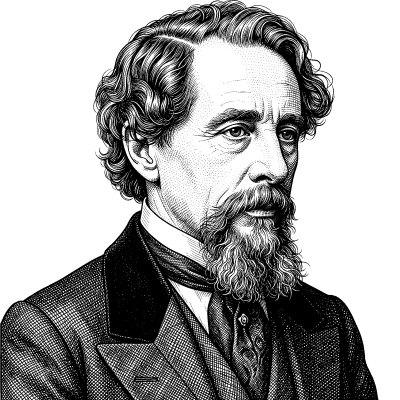
Charles Dickens
Charles John Huffam Dickens (1812-1870) stands as the most widely read English novelist of the Victorian era, a writer whose serialized fiction shaped how an entire society saw its own poverty, ambition, and capacity for change. Born in Portsmouth to a navy clerk whose debts landed the family in financial ruin, Dickens spent part of his boyhood laboring in a London boot-blacking factory while his father sat in debtors’ prison. That early exposure to want and humiliation never left his fiction, and it gave his later success an unusual moral urgency: he wrote not as an observer of the poor but as someone who had briefly been counted among them. Dickens built his career through serialization, publishing novels in monthly or weekly installments that reached readers across every social class. The Pickwick Papers made him famous almost overnight, and he followed it with Oliver Twist, Nicholas Nickleby, David Copperfield, Bleak House, Great Expectations, and A Tale of Two Cities, among many others. He also founded and edited periodicals, Household Words and All the Year Round, which let him pair fiction with journalism and social commentary in the same pages. His public readings, performed with theatrical intensity across Britain and America, turned authorship into a kind of ministry, delivered aloud to audiences who wept and laughed together. His fiction worked by insisting that character is not fixed. Ebenezer Scrooge’s transformation across a single night, prompted by visions of what he had been, was, and might yet become, remains the clearest statement of a conviction that runs through nearly everything Dickens wrote: that a human life, however hardened by circumstance or self-interest, retains the capacity to be remade. He gave that conviction institutional teeth, campaigning for sanitation reform, public education, and the abolition of debtors’ prisons, treating fiction as a lever for actual social transformation rather than mere entertainment. That conviction resonates with a Mormon transhumanist sense of human potential: the idea that growth has no fixed ceiling, that compassion toward the suffering is not sentiment but obligation, and that redemption is available to anyone willing to see differently. Dickens located his hope in moral imagination rather than in theology or technology, and he had no occasion to anticipate debates about engineered futures. But his lifelong case that people and the institutions they build can always become more generous than they currently are gives his work a natural kinship with the aspiration to a more compassionate, more fully realized humanity.
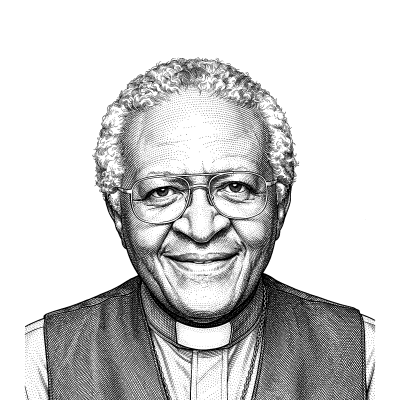
Desmond Tutu
Desmond Mpilo Tutu (1931-2021) was a South African Anglican archbishop who became one of the moral authorities of his century, leading nonviolent resistance to apartheid and later guiding his country through the painful work of reckoning with what apartheid had done. Born in Klerksdorp to a schoolteacher father and a domestic-worker mother, he trained first as a teacher before entering the priesthood, ordained in 1960. He became Bishop of Lesotho in 1976, then Bishop of Johannesburg, and in 1986 became the first Black Archbishop of Cape Town, using the pulpit and the press with equal skill to make apartheid’s injustice visible to a world that preferred not to look. Tutu’s resistance stayed deliberately nonviolent even as the system he opposed grew more brutal, a discipline that cost him surveillance, threats, and the revocation of his passport, and that earned him the Nobel Peace Prize in 1984. After apartheid fell, Nelson Mandela appointed him to chair the Truth and Reconciliation Commission, where he insisted that justice required truth-telling before it could require forgiveness, and that forgiveness, rightly understood, was not an erasure of harm but a costly act of repair. He also popularized the Zulu-rooted concept of ubuntu for audiences well beyond South Africa, teaching that personhood is not a private possession but something realized only through other people. That teaching, captured in his own words, that his humanity is bound up in others’ humanity, for people can only be human together, names a relational view of personhood that resonates with a Mormon transhumanist emphasis on growth achieved in community rather than isolation. Tutu held that every person carries the image of God, and that cruelty against one person wounds that image everywhere. His life’s work, holding truth and reconciliation together rather than letting either substitute for the other, offers a model of moral seriousness for any tradition that hopes human beings might yet become more fully what they were created to be.
Quotations (24)

Topical Guide (22)
See all 22 resultsVideos (5)
Jon Ogden
What If It All Works Out? Positive Visions of AI
This talk asks a hopeful question: What if it all works out? The speaker envisions AI’s positive potential at three levels—garden, city, and planet. At the garden level, he invokes the simple paradise of Epicurus: friends discussing ideas in peaceful surroundings, suggesting we may already be closer to Eden than we realize. But this vision falters when one considers the unhoused sleeping under Zion’s Bank, prompting a turn to the Mormon vision of Zion where there are no poor. Finally, at the planetary level, the speaker sees AI’s greatest promise in its capacity to detect microscopic toxins and enable truly sustainable material cycles—going from “one to zero” as nature does, so that everyone might eventually enjoy the simple luxury of talking about ideas with friends.

Closing Session: a discussion on COVID-19 and the interconnectedness of our world
This closing session roundtable discussion from the 2020 MTA conference explores the COVID-19 pandemic’s effects on global interconnectedness. Participants highlight encouraging developments—from a seventeen-year-old creating a widely-used pandemic dashboard to international cooperation on medical technology and the rapid expansion of remote work and education. The conversation turns to what the MTA can do during the crisis, with participants emphasizing the need to balance transhumanist optimism with genuine empathy for those suffering, the importance of understanding exponential growth’s implications, and the opportunity to strengthen the broader transhumanist movement through increased virtual collaboration.
Jon Bialecki
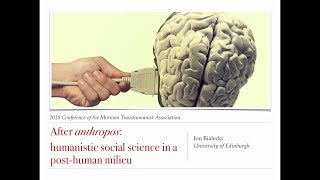
After Anthropos: Humanistic Social Science in a Posthuman Milieu
Anthropologist John Bialecki examines what transhumanism means for a social science that defines itself as the study of the human. He traces anthropology’s Boasian tradition of treating humanity as remarkably plastic yet culturally dependent, then asks whether posthuman transformations—particularly radical scenarios like Churchland’s networked “centipede” minds—would place future beings beyond the reach of ethnographic methods. Bialecki proposes that anthropology’s capacity to study a transformed subject might serve as a test for whether that transformation enhances or abandons what we recognize as human.
Kathy Wilson
Report on humanitarian work in India
Kathy Wilson reports on her experiences traveling to India over twenty years, describing how the country’s explosive population growth—from 800 million to over a billion—has intensified problems of poverty, corruption, and gender inequality while simultaneously expanding her understanding of what is possible on Earth. She shares observations from Delhi slums housing millions of people and discusses her work with NGOs supporting marginalized widows and children. Wilson connects these global humanitarian challenges to transhumanist themes, arguing that as the planet shrinks into a global society, those with technology and education have a responsibility to address problems in developing countries rather than ignore them.
James Felton Keith
Integrationalism: Spiritual Disincentives for Humanity
James Felton Keith presents his philosophy of “integrationalism,” arguing that traditional spirituality—by emphasizing individual spirits and their unique relationship with the divine—inadvertently incentivizes elitism, protectionism, and violent conflict over scarce resources. He proposes that insights from string theory, which suggest all existence is fundamentally interconnected, could provide a new framework for human cooperation. Keith contends that rather than pursuing “moral good” based on relative spiritual beliefs, humanity should focus on protecting mortal lives as inherently valuable, recognizing that our group interdependence is essential for technological and philosophical progress.