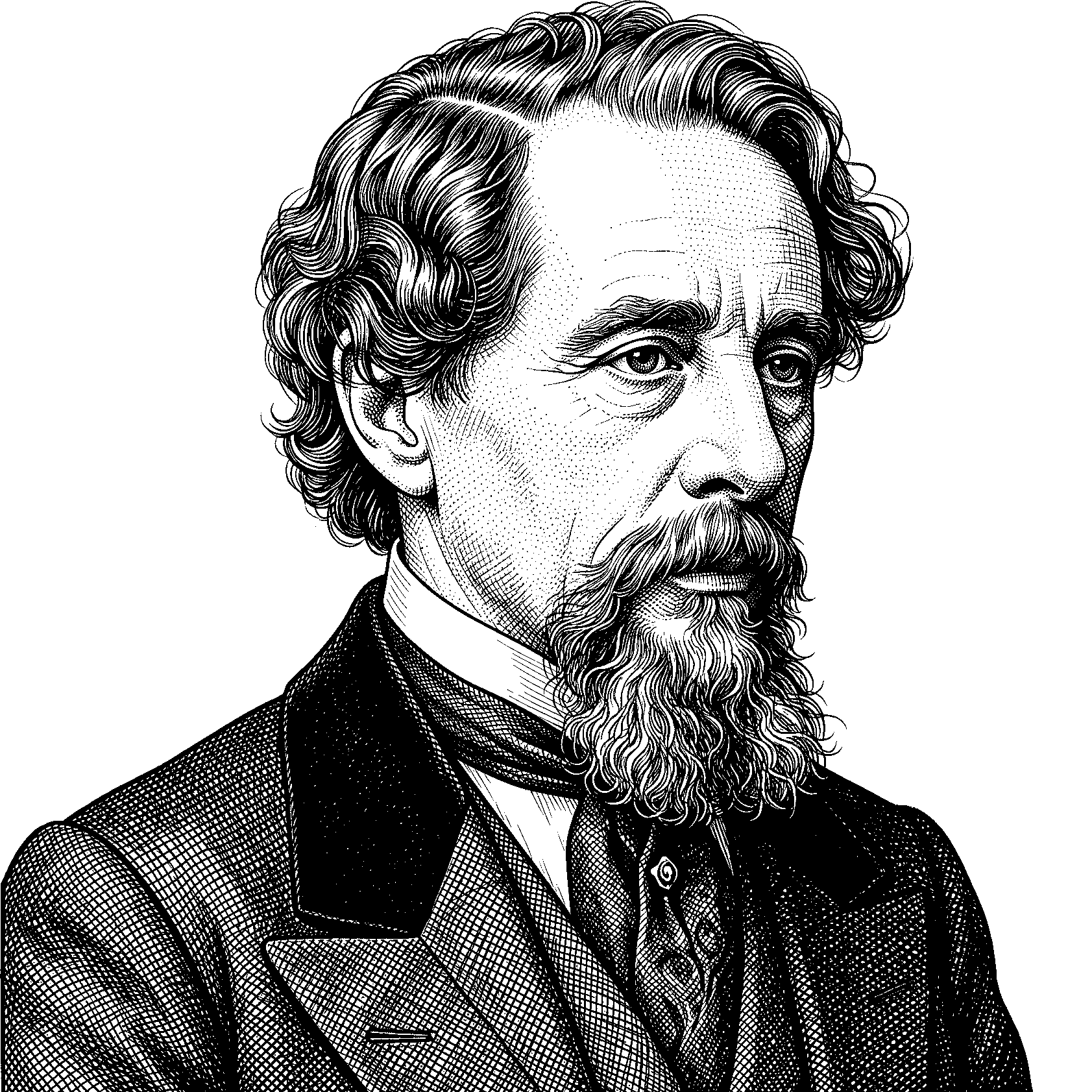
Charles John Huffam Dickens (1812-1870) stands as the most widely read English novelist of the Victorian era, a writer whose serialized fiction shaped how an entire society saw its own poverty, ambition, and capacity for change. Born in Portsmouth to a navy clerk whose debts landed the family in financial ruin, Dickens spent part of his boyhood laboring in a London boot-blacking factory while his father sat in debtors’ prison. That early exposure to want and humiliation never left his fiction, and it gave his later success an unusual moral urgency: he wrote not as an observer of the poor but as someone who had briefly been counted among them.
Dickens built his career through serialization, publishing novels in monthly or weekly installments that reached readers across every social class. The Pickwick Papers made him famous almost overnight, and he followed it with Oliver Twist, Nicholas Nickleby, David Copperfield, Bleak House, Great Expectations, and A Tale of Two Cities, among many others. He also founded and edited periodicals, Household Words and All the Year Round, which let him pair fiction with journalism and social commentary in the same pages. His public readings, performed with theatrical intensity across Britain and America, turned authorship into a kind of ministry, delivered aloud to audiences who wept and laughed together.
His fiction worked by insisting that character is not fixed. Ebenezer Scrooge’s transformation across a single night, prompted by visions of what he had been, was, and might yet become, remains the clearest statement of a conviction that runs through nearly everything Dickens wrote: that a human life, however hardened by circumstance or self-interest, retains the capacity to be remade. He gave that conviction institutional teeth, campaigning for sanitation reform, public education, and the abolition of debtors’ prisons, treating fiction as a lever for actual social transformation rather than mere entertainment.
That conviction resonates with a Mormon transhumanist sense of human potential: the idea that growth has no fixed ceiling, that compassion toward the suffering is not sentiment but obligation, and that redemption is available to anyone willing to see differently. Dickens located his hope in moral imagination rather than in theology or technology, and he had no occasion to anticipate debates about engineered futures. But his lifelong case that people and the institutions they build can always become more generous than they currently are gives his work a natural kinship with the aspiration to a more compassionate, more fully realized humanity.