Authors

Ally Isom is a business and community leader with a diverse background spanning public service, corporate strategy, and political engagement. Currently a Republican candidate for the United States Senate in Utah, she brings a wealth of experience to the political arena. Isom has demonstrated a commitment to fostering authentic human connection, a theme echoed throughout her work and personal interests. This dedication aligns with the Mormon Transhumanist Association’s focus on leveraging technology to enhance human potential and spiritual growth. Prior to her senatorial bid, Isom held prominent positions in Utah state government, including Deputy Chief of Staff and spokesperson for Governor Gary Herbert. She also served in public affairs, communication, and branding roles within the Church of Jesus Christ of Latter-day Saints. Her career transitioned into the private sector, where she served as Chief Strategy and Marketing Officer and, eventually, acting executive officer for Evok Nano, a company focused on innovation and technology. Isom’s presentation at MTAConf 2022 highlighted the vital importance of human connection, particularly in the wake of the COVID-19 pandemic. She explored the neuroscience behind connection, emphasizing its role in strengthening the immune system, promoting mental and emotional well-being, and fostering spiritual growth. This perspective resonates with transhumanist ideals of enhancing human capabilities and experiences through technology and community engagement. Outside of her professional life, Isom enjoys a variety of activities, including riding, hiking, cooking, and indulging in her favorite dish, mole poblano, preferably enjoyed on a beach with a good book. She is married to Eric and they have four children and five grandchildren.

Benjamin Peters
Benjamin Peters (born 1980) is an American media scholar, author, and professor known for his work on the history of communication technologies, information theory, and the social dimensions of digital networks. He serves as the Hazel Rogers Professor of Communication at the University of Tulsa and has held affiliations with several prominent research institutions. Peters is best known for his book How Not to Network a Nation: The Uneasy History of the Soviet Internet (2016), which explores the failed attempts to build a nationwide computer network in the Soviet Union and examines how social and political systems shape technological development. The work received widespread acclaim for its interdisciplinary approach, bridging media studies, history, and science and technology studies. He has also edited Digital Keywords: A Vocabulary of Information Society and Culture (2016), contributing to critical discourse around the language and concepts underpinning the digital age. Peters’s scholarship carries resonance for those interested in the intersection of technology, human potential, and collective aspiration. By investigating how societies envision and fail to realize transformative technological projects, his work illuminates the deeply human—and often ideological—dimensions of networked communication. His research reminds us that the tools we build to connect and elevate humanity are always embedded in moral, political, and even spiritual frameworks. For communities exploring themes of theosis and the cooperative pursuit of transcendence through technology, Peters’s insights into the promises and pitfalls of networked societies offer valuable perspective on how human aspiration and systemic constraints interact in the ongoing project of building a better world.

Cameron Dayton is an American video game creative director, novelist, and writer known for his work in the gaming industry and speculative fiction. He has held prominent creative roles at several major studios, contributing to well-known franchises and original intellectual properties. Dayton served as creative director at Certain Affinity and has worked in narrative and creative leadership positions across the video game industry. He is also the author of the novel Etherwalker , a science-fantasy work set in a far-future world where technology and myth have intertwined, exploring themes of lost civilizations, human potential, and the rediscovery of powerful ancient technologies. His fiction often inhabits the intersection of epic fantasy and science fiction, imagining futures in which humanity’s relationship with technology is both perilous and transformative. Dayton has roots in the Latter-day Saint community, and his creative work reflects an imagination shaped by themes resonant with Mormon Transhumanist thought—particularly the idea that humanity’s trajectory involves the responsible stewardship of extraordinary power, and that the boundaries between the mundane and the transcendent are more porous than they appear. His speculative worlds frequently explore the tension between knowledge and wisdom, technological mastery and moral responsibility, echoing the Mormon Transhumanist conviction that scientific and technological progress are inseparable from ethical and spiritual development. His storytelling invites readers to consider what it means for ordinary individuals to inherit or rediscover capacities that border on the divine—a narrative arc that parallels the Latter-day Saint doctrine of theosis and the transhumanist aspiration toward radical human flourishing.
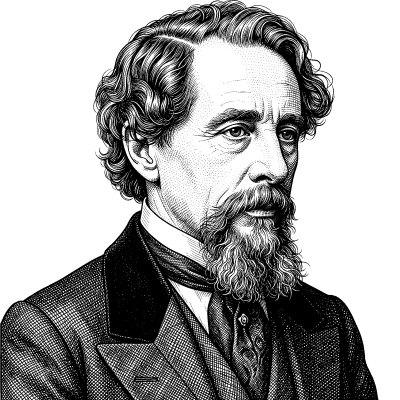
Charles Dickens
Charles John Huffam Dickens (1812-1870) stands as the most widely read English novelist of the Victorian era, a writer whose serialized fiction shaped how an entire society saw its own poverty, ambition, and capacity for change. Born in Portsmouth to a navy clerk whose debts landed the family in financial ruin, Dickens spent part of his boyhood laboring in a London boot-blacking factory while his father sat in debtors’ prison. That early exposure to want and humiliation never left his fiction, and it gave his later success an unusual moral urgency: he wrote not as an observer of the poor but as someone who had briefly been counted among them. Dickens built his career through serialization, publishing novels in monthly or weekly installments that reached readers across every social class. The Pickwick Papers made him famous almost overnight, and he followed it with Oliver Twist, Nicholas Nickleby, David Copperfield, Bleak House, Great Expectations, and A Tale of Two Cities, among many others. He also founded and edited periodicals, Household Words and All the Year Round, which let him pair fiction with journalism and social commentary in the same pages. His public readings, performed with theatrical intensity across Britain and America, turned authorship into a kind of ministry, delivered aloud to audiences who wept and laughed together. His fiction worked by insisting that character is not fixed. Ebenezer Scrooge’s transformation across a single night, prompted by visions of what he had been, was, and might yet become, remains the clearest statement of a conviction that runs through nearly everything Dickens wrote: that a human life, however hardened by circumstance or self-interest, retains the capacity to be remade. He gave that conviction institutional teeth, campaigning for sanitation reform, public education, and the abolition of debtors’ prisons, treating fiction as a lever for actual social transformation rather than mere entertainment. That conviction resonates with a Mormon transhumanist sense of human potential: the idea that growth has no fixed ceiling, that compassion toward the suffering is not sentiment but obligation, and that redemption is available to anyone willing to see differently. Dickens located his hope in moral imagination rather than in theology or technology, and he had no occasion to anticipate debates about engineered futures. But his lifelong case that people and the institutions they build can always become more generous than they currently are gives his work a natural kinship with the aspiration to a more compassionate, more fully realized humanity.

Desmond Tutu
Desmond Mpilo Tutu (1931-2021) was a South African Anglican archbishop who became one of the moral authorities of his century, leading nonviolent resistance to apartheid and later guiding his country through the painful work of reckoning with what apartheid had done. Born in Klerksdorp to a schoolteacher father and a domestic-worker mother, he trained first as a teacher before entering the priesthood, ordained in 1960. He became Bishop of Lesotho in 1976, then Bishop of Johannesburg, and in 1986 became the first Black Archbishop of Cape Town, using the pulpit and the press with equal skill to make apartheid’s injustice visible to a world that preferred not to look. Tutu’s resistance stayed deliberately nonviolent even as the system he opposed grew more brutal, a discipline that cost him surveillance, threats, and the revocation of his passport, and that earned him the Nobel Peace Prize in 1984. After apartheid fell, Nelson Mandela appointed him to chair the Truth and Reconciliation Commission, where he insisted that justice required truth-telling before it could require forgiveness, and that forgiveness, rightly understood, was not an erasure of harm but a costly act of repair. He also popularized the Zulu-rooted concept of ubuntu for audiences well beyond South Africa, teaching that personhood is not a private possession but something realized only through other people. That teaching, captured in his own words, that his humanity is bound up in others’ humanity, for people can only be human together, names a relational view of personhood that resonates with a Mormon transhumanist emphasis on growth achieved in community rather than isolation. Tutu held that every person carries the image of God, and that cruelty against one person wounds that image everywhere. His life’s work, holding truth and reconciliation together rather than letting either substitute for the other, offers a model of moral seriousness for any tradition that hopes human beings might yet become more fully what they were created to be.

Kurtis Lockhart is an urban development leader, researcher, and the Founder and Director of the Africa Urban Lab (AUL). He holds a PhD in political science from the University of Oxford, where his research examined the impact of institutional reforms on public goods provision in sub-Saharan Africa. He also obtained an MSc in Development Management from the London School of Economics—where he graduated top of his class—and a BA in Economics and Development Studies from McGill University. While at Oxford, he taught both quantitative methods and African politics, seamlessly bridging rigorous academic theory with real-world development challenges. Before focusing on urban innovation, Lockhart built extensive on-the-ground expertise managing developmental research and randomized control trials. He served as a Research Manager for the International Growth Centre and Warc Africa in Sierra Leone, and for the ELIMU Impact Evaluation Center in Kenya. These early roles across varied sectors solidified his understanding of the complex bottlenecks facing developing regions and underscored the urgent need for scalable, structural solutions. A prominent advocate for innovative governance, Lockhart previously served as Executive Director and Head of Research at the Charter Cities Institute (CCI), a Washington, D.C.-based think tank. There, he championed the development of charter cities—new urban centers granted special jurisdiction to enact institutional reforms—as a mechanism to address Africa’s rapid urbanization. Expanding on this mission in 2024, he launched the Africa Urban Lab in Zanzibar. Operating as a “teaching hospital” for urban professionals in partnership with the African School of Economics and CCI, AUL trains the next generation of municipal leaders and planners to transform urban growth into economic prosperity. Lockhart’s broader vision aligns deeply with themes of human progress, emphasizing how institutional evolution can lift communities out of poverty and foster long-term resilience. At the MTAConf 2022, he made a presentation on Charter Cities: Empowered Cities for the Urban Age, illustrating how decentralized, empowered cities can overcome traditional development hurdles. By reimagining city governance as a catalyst for human flourishing, Lockhart continues to shape the future of urban resilience and economic freedom across the Global South.

Michaelann Gardner is a speaker who has presented at several Mormon Transhumanist Association conferences. Her presentation at the MTAConf 2019 focused on the impact of family history and ancestral trauma on personal well-being and resilience, particularly in the context of emotional vulnerability and mental health. Gardner’s talk explored the challenges of confronting difficult family narratives and embracing personal messiness and complexity. She drew on personal experiences related to her grandfather, Bert Gardner, and great-grandfather, both of whom struggled with alcoholism and created instability for their families. She connects these family dynamics to broader themes of emotional expression, financial security, and anxiety. She integrates insights from therapy and psychology, referencing research that suggests building resilience through understanding one’s family history. Her work appears to be a combination of personal reflection with family systems and positive psychology.