faith
Articles (119)
Archive: Volume Two
Lincoln Cannon releases Archive: Volume Two (2009–2011), collecting 500+ pages of posts and essays on Mormon Transhumanism and the New God Argument.
Twelve Worlds, One Frontier: Transfigurist Artwork Series
Twelve retro-futurist posters, a year with illustrator Yegor Shustov, and no AI imagery anywhere. The story behind the Transfigurist Artwork Series.
New God Argument Version 4.0
The New God Argument v4.0 offers a logical case for faith in God rooted in science and technology trends—proving that trust in superhuman potential implies trust in God.
New God Argument Version 4.0
The New God Argument v4.0 offers a logical case for faith in God grounded in science and technology trends—proving that trust in superhuman potential implies trust in God.
The Association Has a New Home
Explore the rebuilt transfigurism.org—a deeper library, topical guides, and community tools for those who take both faith and the future seriously.
Authors (2)
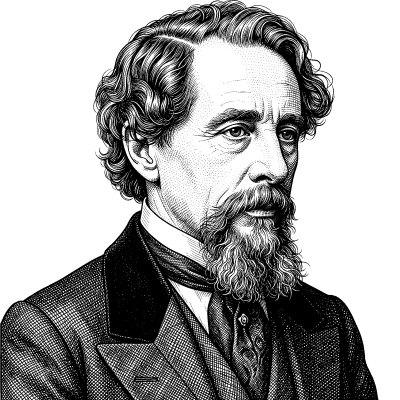
Charles Dickens
Charles John Huffam Dickens (1812-1870) stands as the most widely read English novelist of the Victorian era, a writer whose serialized fiction shaped how an entire society saw its own poverty, ambition, and capacity for change. Born in Portsmouth to a navy clerk whose debts landed the family in financial ruin, Dickens spent part of his boyhood laboring in a London boot-blacking factory while his father sat in debtors’ prison. That early exposure to want and humiliation never left his fiction, and it gave his later success an unusual moral urgency: he wrote not as an observer of the poor but as someone who had briefly been counted among them. Dickens built his career through serialization, publishing novels in monthly or weekly installments that reached readers across every social class. The Pickwick Papers made him famous almost overnight, and he followed it with Oliver Twist, Nicholas Nickleby, David Copperfield, Bleak House, Great Expectations, and A Tale of Two Cities, among many others. He also founded and edited periodicals, Household Words and All the Year Round, which let him pair fiction with journalism and social commentary in the same pages. His public readings, performed with theatrical intensity across Britain and America, turned authorship into a kind of ministry, delivered aloud to audiences who wept and laughed together. His fiction worked by insisting that character is not fixed. Ebenezer Scrooge’s transformation across a single night, prompted by visions of what he had been, was, and might yet become, remains the clearest statement of a conviction that runs through nearly everything Dickens wrote: that a human life, however hardened by circumstance or self-interest, retains the capacity to be remade. He gave that conviction institutional teeth, campaigning for sanitation reform, public education, and the abolition of debtors’ prisons, treating fiction as a lever for actual social transformation rather than mere entertainment. That conviction resonates with a Mormon transhumanist sense of human potential: the idea that growth has no fixed ceiling, that compassion toward the suffering is not sentiment but obligation, and that redemption is available to anyone willing to see differently. Dickens located his hope in moral imagination rather than in theology or technology, and he had no occasion to anticipate debates about engineered futures. But his lifelong case that people and the institutions they build can always become more generous than they currently are gives his work a natural kinship with the aspiration to a more compassionate, more fully realized humanity.
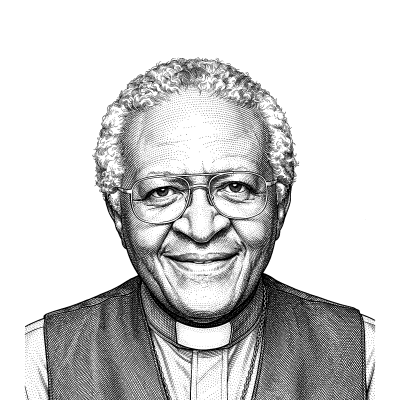
Desmond Tutu
Desmond Mpilo Tutu (1931-2021) was a South African Anglican archbishop who became one of the moral authorities of his century, leading nonviolent resistance to apartheid and later guiding his country through the painful work of reckoning with what apartheid had done. Born in Klerksdorp to a schoolteacher father and a domestic-worker mother, he trained first as a teacher before entering the priesthood, ordained in 1960. He became Bishop of Lesotho in 1976, then Bishop of Johannesburg, and in 1986 became the first Black Archbishop of Cape Town, using the pulpit and the press with equal skill to make apartheid’s injustice visible to a world that preferred not to look. Tutu’s resistance stayed deliberately nonviolent even as the system he opposed grew more brutal, a discipline that cost him surveillance, threats, and the revocation of his passport, and that earned him the Nobel Peace Prize in 1984. After apartheid fell, Nelson Mandela appointed him to chair the Truth and Reconciliation Commission, where he insisted that justice required truth-telling before it could require forgiveness, and that forgiveness, rightly understood, was not an erasure of harm but a costly act of repair. He also popularized the Zulu-rooted concept of ubuntu for audiences well beyond South Africa, teaching that personhood is not a private possession but something realized only through other people. That teaching, captured in his own words, that his humanity is bound up in others’ humanity, for people can only be human together, names a relational view of personhood that resonates with a Mormon transhumanist emphasis on growth achieved in community rather than isolation. Tutu held that every person carries the image of God, and that cruelty against one person wounds that image everywhere. His life’s work, holding truth and reconciliation together rather than letting either substitute for the other, offers a model of moral seriousness for any tradition that hopes human beings might yet become more fully what they were created to be.
Quotations (17)
Topical Guide (10)
See all 10 resultsVideos (9)
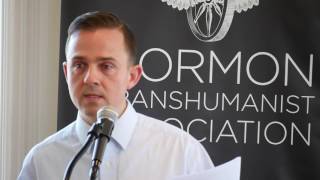
Carl Youngblood
‘Help Thou Mine Unbelief’: Rescuing Faith in a Post-Secular Era
Carl Youngblood examines the crisis of faith in Mormonism’s post-secular era, where widespread access to information has made it difficult for the LDS Church to control its narrative. Drawing on Paul Tillich’s theology, he critiques common responses—apologetics, appeals to authority, fundamentalism, and secularism—as inadequate because they either mistake finite constructs for ultimate concern or abandon the symbols that give faith its vitality. Youngblood quotes B. H. Roberts’s call for “disciples of the second sort” who bring personal contributions to received truth rather than merely repeating formulas, and he positions the Mormon Transhumanist Association as cultivating such disciples.
Don Bradley
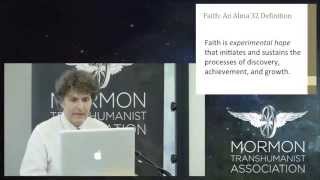
An Experiment Upon the Word
Don Bradley analyzes Alma 32 as a post-biblical, post-Enlightenment reformulation of faith that draws on Jesus’s parables while transforming their meaning through scientific language. He argues that whereas the New Testament presents “taking no thought” favorably as trust in God’s providence, the Book of Mormon redeploys this phrase negatively—faith requires actively “arousing faculties” and conducting “experiments” rather than passive belief. Bradley identifies distinctly scientific vocabulary throughout Alma’s discourse (experiment, dormant, particle, discernible) and proposes a working definition: “faith is experimental hope that initiates and sustains the processes of discovery, achievement, and growth.” He suggests Latter-day Saints should learn to engage scripture through midrash—the Jewish tradition of creatively rewriting narratives to apply them to contemporary life.
You Are the New Day
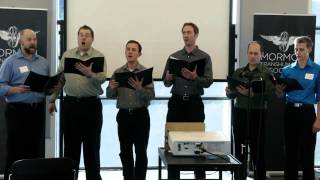
The MTA Barbershop Chorus performs John Rutter’s “You Are the New Day,” a hymn of hope and renewal. Introduced by a reflection on humanity’s responsibility to shape the future through “good minds and loving hearts,” the performance celebrates themes of love, life, and the dawning possibility of each new day—affirming that hope persists even when time seems to be running out.
Jared Anderson
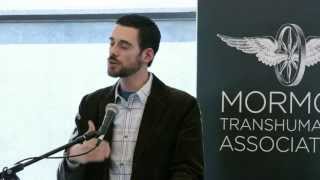
(De)Construction down the Rabbit Hole
Jared Anderson explores three approaches to faith crisis: apologetics, which defends inherited beliefs but leaves adherents vulnerable to new information; selective emphasis, which rebuilds meaning by highlighting a tradition’s most beneficial elements; and complete reconstruction through new myths and systems of meaning. Anderson argues that critical inquiry can only demolish worldviews—reconstruction is an art requiring theology, aesthetics, relationships, heritage, syncretism, and activism. He concludes that humanism and transhumanism offer frameworks for rebuilding when the “rabbit hole goes all the way down.”
Micah Redding
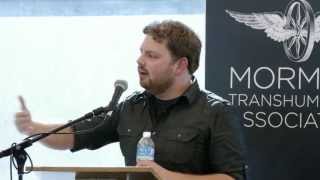
A Better Apocalypse: Ancient Eschatology for a Transhuman World
Micah Redding contrasts the failed end-of-world predictions exemplified by Harold Camping with the ancient Jewish prophetic tradition that viewed apocalypse not as history’s arbitrary termination but as moments when oppressive powers are overwhelmed by the rising tide of justice. He argues that this “better apocalypse” drew people more deeply into the world rather than out of it, inspiring figures like Martin Luther King Jr. to stand for truth even when victory seemed impossible. Redding suggests that spiritually oriented transhumanists can offer a similar forward-looking vision—one that calls humanity to courage and engagement rather than despair.